Trial with the Defendant Acting as His Own Counsel
The RoomThe Trial with the Defendant Acting as His Own Counsel is a courtroom conflict in which the Unnamed prisoner and defendant tries to challenge the prosecution without a lawyer, while the court repeatedly limits how he may proceed. Its significance lies not only in the testimony about a man seen at Kramers Jewelry Store, but in the contrast between formal procedure and the defendant’s conviction that the legal system will not give him a fair chance to use it.
From Preliminary Hearing to Self-Representation
The trial follows an earlier preliminary hearing that establishes why the defendant regards legal representation with suspicion. As the charges are read, he recognizes only fragments of the formal language; the rest reaches him as sound rather than meaning. He pleads not guilty, but barely registers the public defender beside him. The defender gives him paper and a pencil, asks him to write down questions instead of interrupting testimony, and then turns to his papers. The defendant interprets this distance as proof that the lawyer has already abandoned him.
At first, he tries to follow the arresting officers’ testimony and note discrepancies that might help the defense. He cannot find words for what he wants to record, however, and his attention falters as the hearing proceeds through stipulations, waived matters, and legal arguments. The defender moves to dismiss the case by citing prior decisions; the prosecutor argues against dismissal, and the judge later denies the motion. To the defendant, the hearing’s formal exchanges do not feel like meaningful advocacy. He remembers his lawyer as having let everything pass without trying to help.
The hearing also leaves him with a distorted sense of time that shapes the courtroom episodes around it. He recalls being awakened at about 5:30 and returning to his cell after 7:30, yet describes the day as fourteen hours of waiting and movement: from the bench to holding tanks, from chains to a bus, then to the courthouse and back through the same sequence. In the cell, he can replay those fourteen hours in minutes. He concludes that the hours, meals, and permanently lit nights have become indistinguishable. The court experience is thus measured both as an exhausting institutional itinerary and as a blur in which he cannot retain the details he hoped to use.
The Trial as a Contest over Procedure
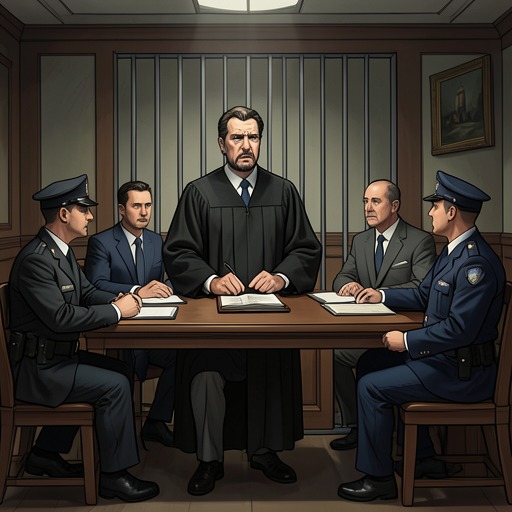
At the later trial, the court makes explicit that the defendant chose to act as his own counsel despite contrary advice and the availability of a public defender. When he continues questioning a witness about whether there were lights in the store window, the prosecutor objects that the matter has already been established by expert testimony. The prosecutor points to testimony from the Department of Water and Power, the burglar-alarm company, and a report from the United States Weather Bureau. The court agrees that the line of questioning is unreasonable and unnecessary.
The judge then gives the defendant another opportunity to accept representation for the remainder of the trial. He declines. The court warns him that proper trial procedures must be followed and that he may be held in contempt. This exchange marks the central procedural tension: the defendant retains the choice to represent himself, but that choice does not exempt him from the court’s rules about relevant questions and repetition. From his perspective, however, the restriction confirms his belief that the system will not let him make his case on his own terms.
That tension echoes his broader account of law and policing. In a passage imagining a public denunciation of police power, he calls the state a Police State and argues that obscure laws give officers opportunities to harass citizens. He points to the many laws an ordinary person cannot know and imagines petty violations being used vindictively. These assertions are his political interpretation, not findings made by the court. They nevertheless clarify why procedural limits in the trial strike him as more than courtroom management: he reads them as part of a wider structure that can exercise authority while denying ordinary people control over how they answer it.
Evidence and the Doorway Account
The questioning centers on what an officer saw at the doorway of Kramers Jewelry Store. The defendant asks whether the witness saw someone there and told his partner to stop the car. The officer rejects that framing: the car was already slowing for a red light as it approached the intersection, and he saw a man in the doorway then. The distinction matters to the account of how the observation occurred. The testimony does not describe a car stopped because the officers had already identified someone at the store; it places the sighting as the vehicle approached a red light.
The defendant’s questions press on how much the witness could actually know. In the exchange, the witness acknowledges that there were lights in the store window, while the prosecutor and court treat that point as already covered by other testimony. The objection does not itself establish what the defendant was trying to prove with the question, and the supplied exchange does not settle the ultimate evidentiary dispute. It shows instead how his effort to test the account meets an opposing claim that the relevant facts have already been proven, followed by the judge’s ruling that further questioning is unnecessary.
The hearing’s competing voices make the trial feel like a struggle over the boundaries of evidence as much as a search for facts. Counsel objects, the prosecutor objects to repeated questions, and the court sustains objections or orders the participants to maintain order. The defendant’s words and questions are therefore heard within a structure that can stop them, redirect them, or treat them as procedurally improper. The testimony about the doorway remains specific, but the scene also foregrounds who has the authority to decide when a question has gone far enough.
After the Courtroom: Distrust and Consequence
The defendant’s inner response turns the legal exchange into a general indictment of unequal justice. He recalls people receiving severe consequences for small thefts, contrasts them with wealthy defendants who can afford teams of lawyers, and imagines that a lawyer such as Stacey Lowry would consider representing someone like him beneath his dignity. These are the defendant’s bitter claims and examples, not independently confirmed accounts in the courtroom scene. Their force comes from the way he connects the immediate experience of being interrupted with a larger conviction that money determines who can defend themselves effectively.
He also suspects that legal rules are deployed whenever a self-represented defendant gains ground, describing the system as a succession of technicalities that makes winning impossible. The account places this suspicion beside the actual exchange: the court expressly offers him a lawyer, he refuses, and the judge warns that the rules of trial procedure still apply. Neither fact erases the other. His refusal is an exercise of choice, while his subsequent frustration shows how little confidence he has that the available choices can produce a fair hearing.
The event consequently ends, in the supplied material, without a verdict or a resolution of the underlying case. What it establishes is the defendant’s insistence on speaking for himself, the court’s insistence on procedural control, and the deepening gulf between his view of justice and the institution’s management of the trial. The courtroom does not convert his distrust into proof that every accusation is true; instead, it shows how each objection and warning becomes further evidence, in his own interpretation, that the system is aligned against him.